


The bleeding-disorder world spent the past few days in Paris at the International Society on Thrombosis and Haemostasis (ISTH) Congress, and the readouts share a preoccupation that has little to do with whether these drugs stop bleeds. They do. The contest now is how rarely a patient has to think about the disease at all.
Two stories carry that today: Novo trying to unseat a Roche blockbuster before regulators weigh in this quarter, and two companies of very different sizes trying to pull von Willebrand disease out of the infusion chair.
Novo's Better Pen
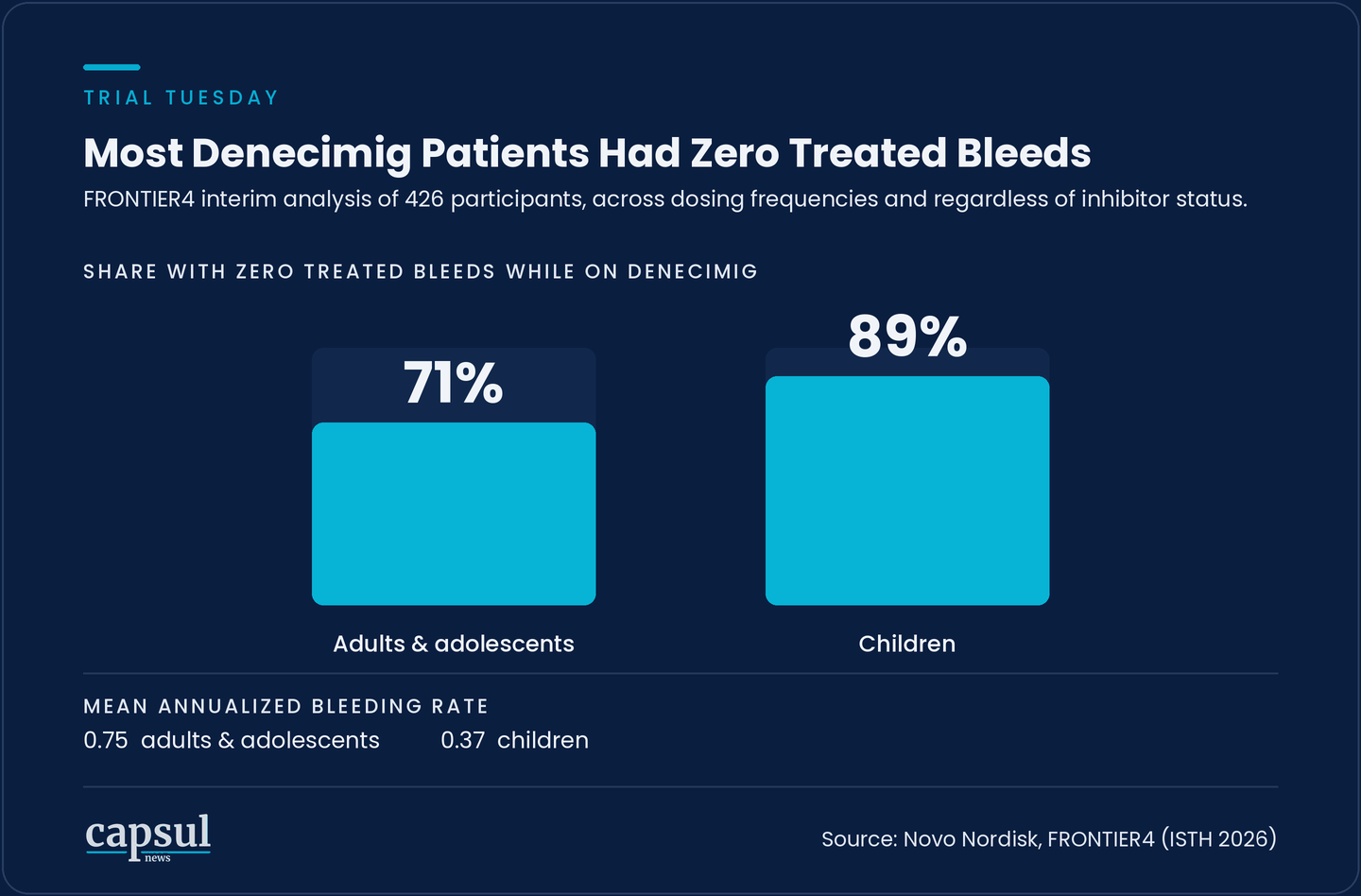
Novo Nordisk is waiting on two verdicts. The FDA and the EMA are both expected to rule on denecimig, its Factor VIIIa-mimicking antibody for hemophilia A, this quarter, and in the meantime, the company keeps adding to the file. At ISTH, it presented an interim analysis from the FRONTIER4 extension study covering 426 people across children, adolescents and adults, treated with or without inhibitors, on schedules that ranged from weekly to monthly. Estimated mean annualized bleeding rates were 0.75 for adults and adolescents and 0.37 for children. Across all doses, 71% of adults and adolescents and 89% of children had zero treated bleeds.
The drug it wants to displace is Hemlibra, Roche's emicizumab, which works the same basic way: a bispecific antibody that stands in for missing Factor VIIIa so blood can clot. It has been the standard of care in hemophilia A, with a 2018 label expansion broadening its use to all patients, including those without inhibitors, and it is not a small thing to take on. First-quarter sales this year were CHF 1.19bn, about $1.47bn, up 13% at constant currencies.