


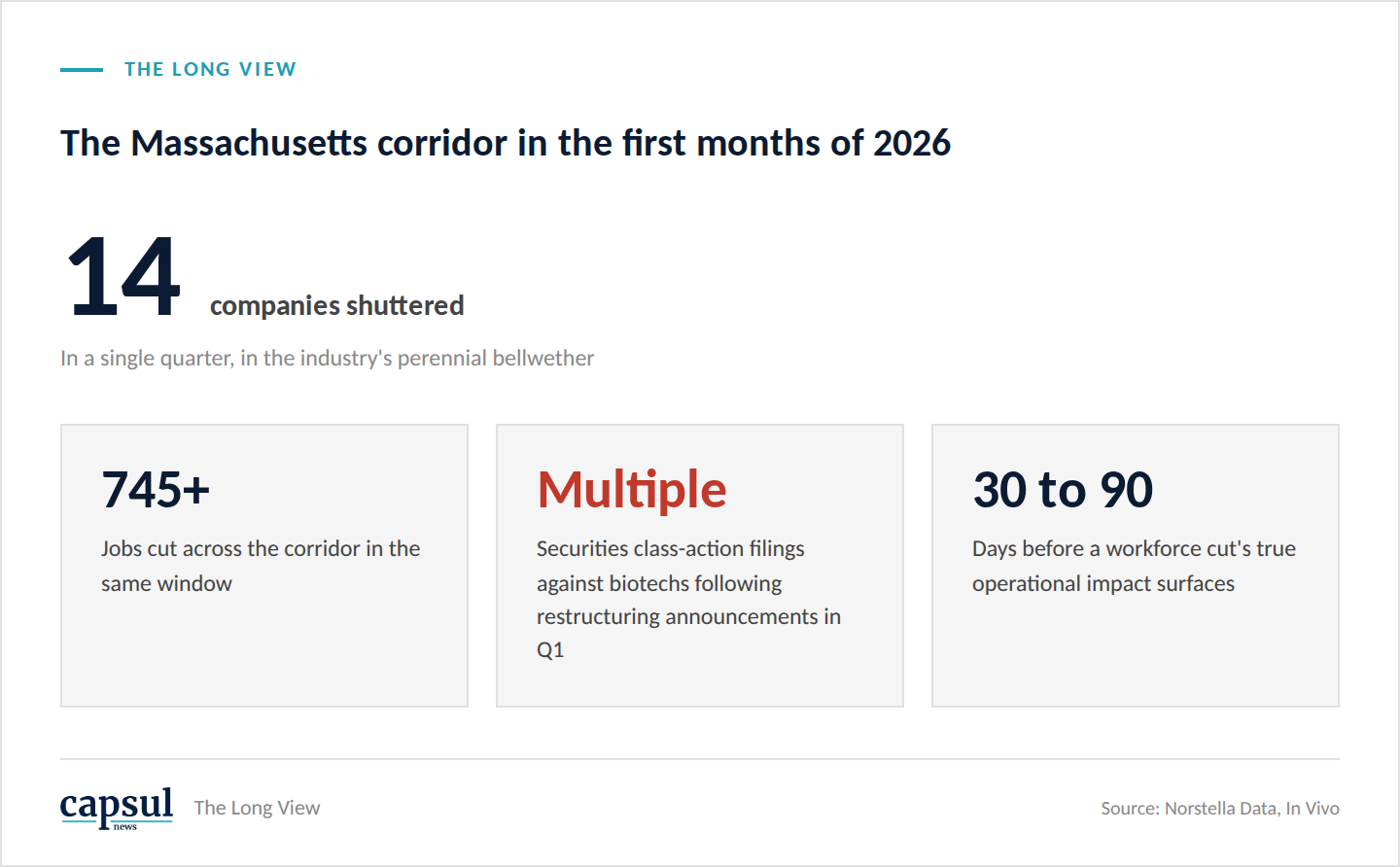
Fourteen companies shuttered in the Massachusetts life sciences corridor in the first months of the year, and at least 745 jobs gone with them. The boardroom instinct is to reach for clinical language: extending runway, right-sizing the organization.
This week is a good moment to sit with what that language is covering for, because the corridor is the industry's perennial bellwether, and the signal it is sending is not really about headcount.
Scaling has always been the vocabulary of biotech growth. But when a company contracts, cutting headcount to survive to the next milestone, the structural risks that accumulate are distinct from those created by expansion, and they are frequently underestimated. Call it fragile scaling: the process of shrinking a team without fracturing the infrastructure that keeps a biotech viable. The danger is not just that there are fewer people to do the work. It's that the work itself becomes fundamentally more precarious.
The most acute version of this risk is what the industry loosely calls "key person" exposure. In early-stage biotech, the institutional knowledge that holds a program together, regulatory strategy, scientific expertise, CRO relationships, is often concentrated in a handful of individuals. When those people leave, the company does not simply lose headcount. It may inadvertently trigger "material change" clauses embedded in financing agreements or collaboration contracts. The runway extension becomes the event that puts the next funding round at risk.
THE 30–90 DAY DANGER ZONE
The true impact of a workforce reduction is rarely felt at the moment the announcements go out. Instead, it surfaces 60 or 90 days later when a regulatory deadline is missed, a security protocol is bypassed, or a data room remains unaudited since the offboarding rush. Three blind spots recur consistently in this window.